

KUN 2 Driver Explained: Excursion, Magnetic Circuit and Dual-Stage Damping
An engineering guide to the GK KUNTEN PRO KUN 2 driver, including diaphragm excursion, voice-coil travel, magnetic drive, dual-stage damping and evidence limits.
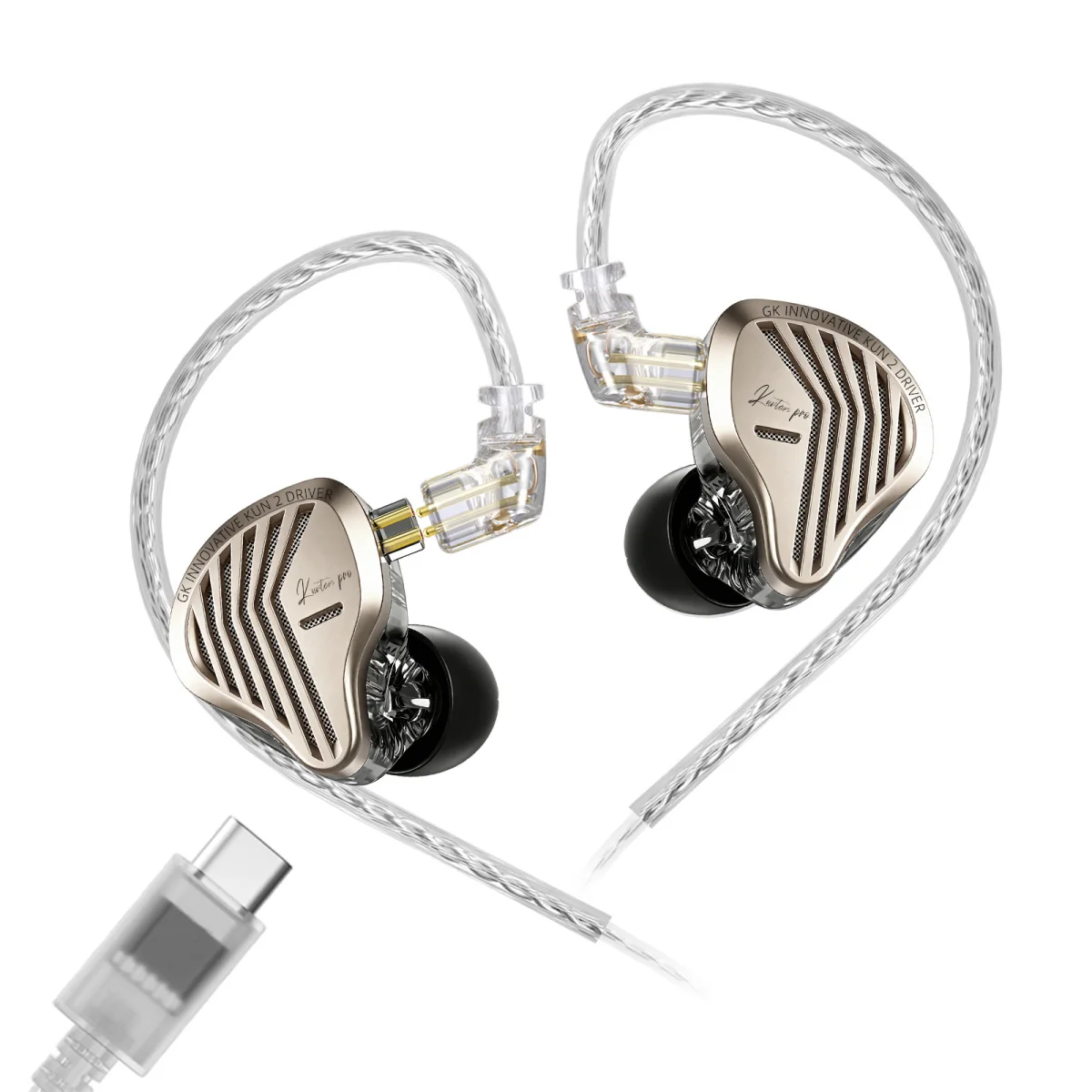
What this guide can and cannot establish
GK's KUNTEN PRO product sheet identifies four linked changes around the 10mm KUN 2 dynamic driver: re-tuned surround compliance, optimized voice-coil travel, extended low-frequency excursion and a second-generation magnetic circuit. A dual-stage damping filter then manages the acoustic output. Those construction details are the evidence base for this guide.
They do not, by themselves, prove a particular sound signature, distortion level or advantage over another earphone. Where GK describes deeper bass, clearer vocals or stronger control, we label that as a manufacturer target rather than an independent result.
Excursion: how far the diaphragm can travel
Excursion is the diaphragm's displacement from its resting position. Low frequencies require moving air over longer periods, so available displacement matters. A driver can increase acoustic output by moving a larger area, moving farther, or combining both. KUN 2 remains a 10mm driver; GK's stated change is greater usable low-frequency excursion.
More travel is not automatically more useful bass. The diaphragm must accelerate, stop and reverse without excessive rocking, compression or distortion. Seal, enclosure volume, venting and tuning also influence the result. That is why the official sheet pairs extended excursion with changes to the surround and voice coil.
Surround compliance and voice-coil travel
The surround is the flexible boundary that lets the diaphragm move while helping it return toward rest. Compliance describes how readily that suspension moves under force. GK says KUN 2 uses re-tuned surround compliance rather than the original KUN design.
The voice coil sits in the magnetic field and converts current into force. Its allowed travel has to match the diaphragm's mechanical range. If the coil leaves the useful magnetic region or the suspension reaches a nonlinear limit, extra movement can increase distortion instead of clean output. “Optimized voice-coil travel” therefore describes coordination between the moving assembly and the magnetic system; the product sheet does not publish the winding dimensions or maximum linear excursion needed for a numerical analysis.
The second-generation magnetic circuit
A dynamic driver produces force through the interaction between current in the voice coil and magnetic flux in the gap. KUNTEN PRO retains a stated 0.15mm magnetic gap while moving to a second-generation magnetic circuit. A narrow, well-controlled gap can concentrate flux around the coil, but performance also depends on magnet material, pole geometry, coil position and manufacturing tolerance.
GK has not published flux density, force-factor curves or magnet-grade details for KUN 2. We can therefore say that the magnetic circuit was revised to support the intended longer travel, but we cannot calculate its motor strength or compare linearity from the product sheet alone.
Dual-stage damping solves a different problem
The driver creates motion; acoustic damping controls how that motion couples to the air path. Damping elements add frequency-dependent resistance and can reduce resonant buildup. GK's exploded diagram shows a metal filter mesh and a dual-stage damping filter in the KUNTEN PRO acoustic assembly.
GK says the two-stage filter regulates low-frequency energy and reduces ringing or muddiness, targeting more bass without masking vocals and small details. The exact acoustic resistance, material and transfer function are not published. It would be inaccurate to infer a crossover frequency or claim that every two-stage filter behaves the same way.
How the system fits together
- Electrical input: the source drives a 43Ω load; published sensitivity is 109dB/mW at 1kHz.
- Magnetic force: the second-generation circuit acts on the voice coil inside the retained 0.15mm gap.
- Mechanical motion: coil travel and surround compliance define how the 10mm diaphragm can move.
- Acoustic control: enclosure, vents and dual-stage damping shape the energy reaching the nozzle.
- Observed response: fit, seal, source, unit variation and measurement method affect the final result.
This chain is why one component cannot explain the whole earphone. The dynamic driver vs balanced armature guide covers the underlying transducer types; this page focuses on KUN 2's published implementation.
How to read the published specifications
The stated 20-40000Hz frequency range is a bandwidth claim, not a graph of tonal balance and not proof of audible extension at equal level. The 43Ω impedance and 109dB/mW sensitivity describe electrical loading and efficiency at the stated reference, not preferred listening volume. The frequency-response curve shown in the product sheet is a GK laboratory measurement and may vary with fixture, seal and unit.
What independent validation would require
A technical validation should disclose the measurement fixture, coupler, insertion depth, seal, smoothing, calibration, drive level and comparison units. Frequency response alone would not confirm excursion control; distortion versus frequency and level, compression, unit matching and repeatability would add relevant evidence. Until such data exist, KUN 2's structure can be described precisely while its audible advantage remains an open test question.
For the complete values and current launch boundary, see the GK KUNTEN PRO official specifications. For a source-bound generation comparison, read KUNTEN PRO vs KUNTEN.